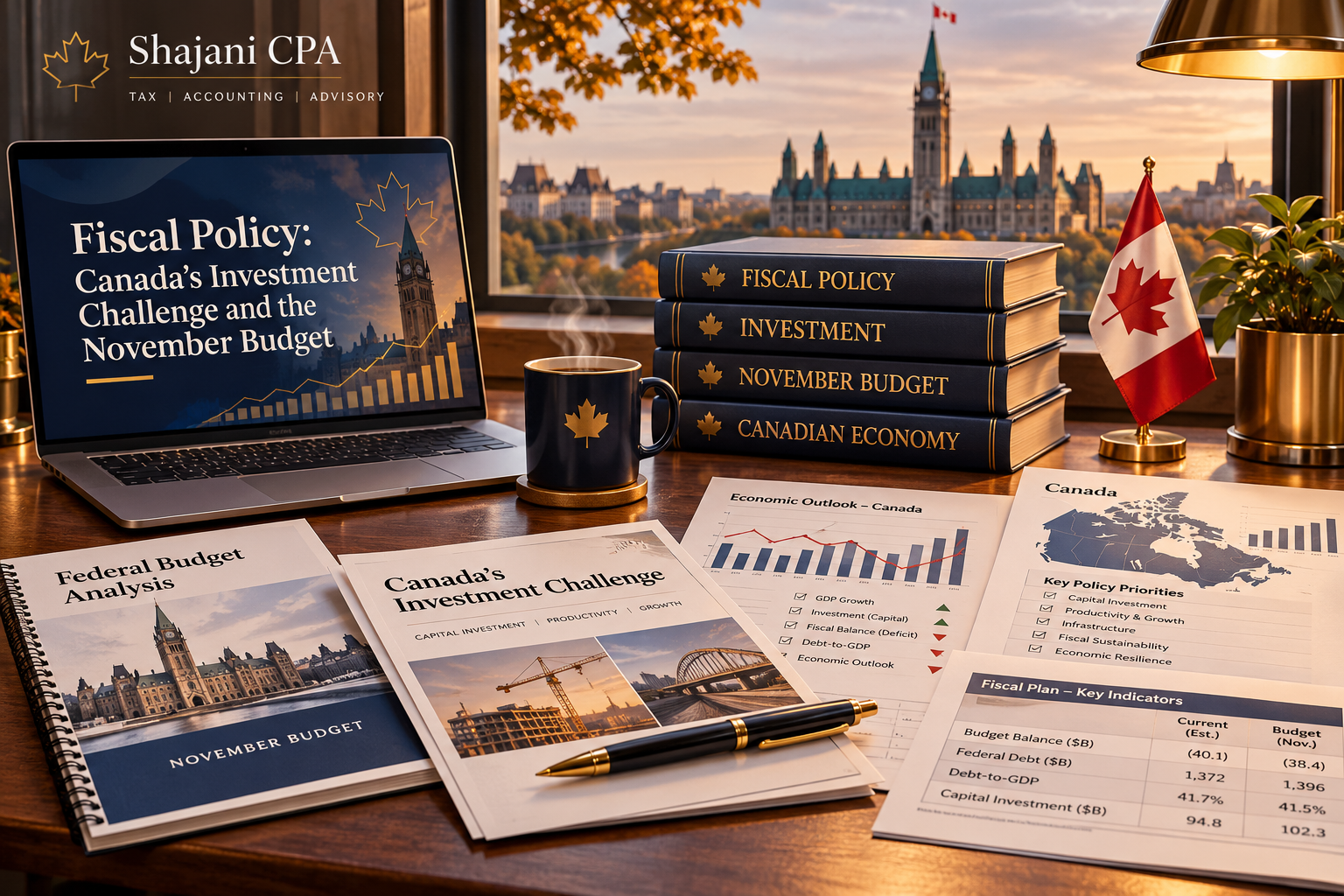

On November 5, 2026, the Minister of Finance and National Revenue, the Honourable François-Philippe Champagne,…

Tax Strategies for a Sole Proprietors in Canada A Strategic, Statutory, and CRA-Anchored Guide for Family-Owned Enterprises
Expanded Executive Introduction — Tax Planning Is Not a Deduction List (1,000+ words)
Purpose
- Reframe “tax minimization” as structural and temporal planning
- Establish authority and audience alignment
- Set expectations: this is not a checklist, but a strategy guide
Key themes (expansion of your opening paragraphs)
- Why most sole proprietor “tax strategies” fail in practice
- The danger of tactical deductions without structural awareness
- Sole proprietorship as a temporary tax posture
- Why CRA guidance explains how, not when or why
- Family-owned enterprises face compounding risk because:
- Income, assets, and risk sit with one person
- Planning errors cascade across years
Statutory anchors
- ITA s. 2(1)
- ITA s. 3
- ITA s. 9
- ITA s. 248(1)
CRA sources
- CRA – Small businesses and self-employed income
- CRA – Sole proprietorship
Section 1 — Strategic Use of Start-Up and Early-Stage Losses (1,000+ words)
(Major expansion of “Leveraging Start-Up Losses”)
Core strategy
- Losses as a planning tool, not an entitlement
Expanded analysis
- What constitutes a non-capital loss for sole proprietors
- Timing losses against high-rate personal income
- Carryback vs carryforward decisions
- When not to use losses immediately
- CRA scrutiny of repeated losses
- Reasonable expectation of profit (CRA lens)
Statutory anchors
- ITA s. 111
- ITA s. 3(d)
CRA sources
- T4002 – Losses
- CRA – Self-employed income
Section 2 — Optimizing Business Deductions Without Triggering CRA Risk (1,000+ words)
(Expansion of “Maximizing Deductions”)
Core strategy
- Deduct everything you are entitled to—but no more
Expanded analysis
- Purpose test under ITA s. 18(1)(a)
- Personal vs business expense boundary
- High-risk deduction categories:
- Automobile (include link to CRA site for current rates)
- Home office (include link to CRA site for current rates)
- Meals & entertainment (include link to CRA site for current rates)
- Travel and conventions (include link to CRA site for current rates)
- Reasonableness standard
- Documentation expectations
Statutory anchors
- ITA s. 18(1)
- ITA s. 20
CRA sources
- T4002 – Business expenses
- CRA – Keeping records
Section 3 — Capital Cost Allowance as a Planning Lever, Not a Reflex (1,000+ words)
(Expansion of “Acquiring Business Assets”)
Core strategy
- CCA is elective and strategic
Expanded analysis
- “Available for use” rules
- Half-year rule
- When claiming CCA hurts future planning
- CCA vs recapture trade-offs
- Impact on exit and goodwill
- Why end-of-year asset purchases require caution
Statutory anchors
- ITA s. 13
- ITA s. 20
CRA sources
- T4002 – Capital cost allowance
- CRA – Capital assets
Section 4 — RRSPs, CPP, and Personal Tax Integration for Sole Proprietors (1,000+ words)
(Major expansion of “RRSPs: A Tax Minimization Tool”)
Core strategy
- Personal retirement planning is tax planning for sole proprietors
Expanded analysis
- RRSP deductions vs business deductions
- Optimal RRSP use in high-income years
- RRSP withdrawals in loss or low-income years
- CPP contributions: cost vs benefit
- Why CPP accelerates incorporation timing
Statutory anchors
- ITA s. 146
- CPP Act (high-level reference only)
CRA sources
- CRA – RRSPs
- CRA – CPP for self-employed individuals
Section 5 — Capital Gains, Capital Losses, and Timing Dispositions (1,000+ words)
(Expansion of “Capital Gains and Losses”)
Core strategy
- Timing matters more than rate
Expanded analysis
- Capital vs income characterization
- Using capital losses against capital gains
- Disposition planning for business assets
- Why sole proprietors lack LCGE access
- Interaction with CCA recapture
Statutory anchors
- ITA ss. 38–40
- ITA s. 13
CRA sources
- CRA – Capital gains
- T4002 – Capital assets
Section 6 — Income Splitting: What Works, What Fails, and What Triggers CRA (1,000+ words)
(Expansion of “Income Splitting Opportunities”)
Core strategy
- Income splitting exists—but is narrower than most believe
Expanded analysis
- Reasonable salaries to family members
- Documentation and reasonableness tests
- Why informal splitting fails
- Partnerships vs sole proprietorship limits
- Interaction with attribution concepts (high-level only)
Statutory anchors
- ITA s. 67
- ITA s. 18(1)(a)
CRA sources
- CRA – Paying salary to family members
- CRA – Business expenses
Section 7 — GST/HST, Instalments, and Cash-Flow-Driven Tax Strategy (1,000+ words)
(Expansion of cash-flow planning themes)
Core strategy
- Tax minimization without cash-flow planning fails
Expanded analysis
- GST/HST registration thresholds
- Input tax credits vs remittance discipline
- Instalment planning
- Why CRA enforcement changes behavior
- When cash-flow pressure signals structural change
CRA sources
- CRA – GST/HST for self-employed
- CRA – Instalment payments
Section 8 — Knowing When Tax Strategies Are Exhausted: The Incorporation Pivot (1,000+ words)
(Logical extension of your prior conclusion)
Core strategy
- Optimization has limits within a sole proprietorship
Expanded analysis
- When deductions and RRSPs no longer move the needle
- Marginal tax rate compression
- CPP burden tipping point
- Structural inefficiency signals
- Why CRA will never tell you to incorporate
Statutory contrast
- ITA s. 2(1) vs s. 2(2)
CRA sources
- CRA – Business structures
- CRA – Incorporating your business
Conclusion — From Tax Minimization to Tax Strategy (1,000+ words)
Synthesis
- Tax strategies are sequential, not simultaneous
- Sole proprietorship planning is about timing
- Families must align tax structure with ambition
Soft brand close
- Trusted advisor framing
- “Tell us your ambitions, and we will guide you there.”
Section 1 — Strategic Use of Start-Up and Early-Stage Losses
For many Canadian sole proprietors, business losses are treated as a consolation prize: an unfortunate but at least “useful” by-product of getting started. That mindset is understandable—and incomplete. Losses are not merely something to endure or casually apply against other income. Properly understood, business losses are a planning tool, one that can materially influence cash flow, audit risk, future flexibility, and the timing of larger structural decisions such as incorporation.
For family-owned enterprises, where personal income, household stability, and business growth are tightly linked, early-stage loss planning is often the difference between a business that survives its formative years and one that quietly accumulates tax and compliance problems. This section reframes losses not as an entitlement, but as a strategic resource that must be used deliberately and within the boundaries set by the Income Tax Act and CRA administration.
Losses Are a Planning Tool, Not an Entitlement
The Canadian tax system does not reward losses for their own sake. It allows them because business activity is inherently risky and uneven, particularly in the early stages. When expenses exceed revenues, the law permits that shortfall to reduce taxable income, recognizing that taxation should apply to net economic gain, not gross receipts.
However, this allowance is conditional. Losses must arise from a business carried on with a view to profit. They must be computed properly. And they must be used in a way that is consistent with the overall structure of the Act.
For sole proprietors, this conditionality is often overlooked. Because losses flow directly to the individual’s personal return, there is a tendency to treat them as automatically available and always beneficial. In practice, the way losses are generated, reported, and applied can either strengthen or weaken the proprietor’s overall tax position.
What Constitutes a Non-Capital Loss for Sole Proprietors
At the technical level, most early-stage business losses incurred by sole proprietors manifest as non-capital losses. A non-capital loss arises when deductible expenses exceed income from all sources in a taxation year, not just business income.
This distinction matters. A business loss on its own does not exist in isolation. It interacts with employment income, investment income, and other personal sources. When aggregated under the income computation rules, a sufficiently large business loss can push total income below zero, creating a non-capital loss.
The statutory authority for the use of non-capital losses is found in ITA section 111, while ITA section 3(d) governs how losses factor into the overall income computation. Together, these provisions allow non-capital losses to be carried back to prior years or carried forward to future years, subject to time limits.
CRA’s administrative guidance, particularly in Guide T4002, explains how these losses are calculated and reported for self-employed individuals. While the mechanics are straightforward, the planning implications are not.
Timing Losses Against High-Rate Personal Income
One of the most powerful features of sole proprietor losses is their ability to offset high-rate personal income. For many families, the business is started alongside employment income or investment income that is already taxed at significant marginal rates. In this context, an early-stage business loss can produce immediate and meaningful tax relief.
However, the timing of loss utilization matters.
Using losses in a year where personal income is already low may produce little benefit. Using them in a year where income is taxed at top marginal rates can generate substantial savings. This is why loss planning cannot be separated from broader personal tax planning.
For example, a sole proprietor with stable employment income may benefit from using early business losses immediately to reduce current tax payable. Conversely, a proprietor whose income fluctuates or who anticipates a high-income year in the near future may be better served by preserving losses for later use.
The Act allows this flexibility, but it does not tell you when to exercise it. That judgment requires forecasting, not form-filling.
Carryback Versus Carryforward: A Strategic Choice
Non-capital losses may generally be carried back up to three taxation years or carried forward up to twenty taxation years. This creates a choice that is often treated as mechanical but is, in reality, strategic.
A carryback produces an immediate refund by reducing tax previously paid. This can be invaluable in the early stages of a business, when cash flow is tight and external financing is limited. For family-owned enterprises, a refund can provide breathing room without increasing debt or personal financial stress.
A carryforward, on the other hand, preserves the loss for use against future income. This may be preferable where current income is modest but future profitability is expected to be strong. In such cases, using the loss later can shelter income that would otherwise be taxed at higher marginal rates.
CRA’s guidance permits both approaches, but it does not evaluate which is “better.” That assessment depends on anticipated income patterns, household needs, and the likely evolution of the business.
When Not to Use Losses Immediately
One of the most counterintuitive aspects of loss planning is that using a loss as soon as it arises is not always optimal.
There are several scenarios where restraint is warranted. If a loss reduces taxable income below the level at which non-refundable credits can be fully used, part of the tax benefit may be effectively wasted. Similarly, if the loss is applied in a year with low marginal rates, the permanent tax savings may be minimal compared to what could have been achieved later.
There is also a behavioural dimension. Automatically using losses each year can mask underlying business performance issues. A business that appears “manageable” after tax may, in reality, be persistently unprofitable. From CRA’s perspective, this pattern can invite scrutiny, particularly if losses recur without a credible trajectory toward profitability.
In other words, losses should be used intentionally, not reflexively.
CRA Scrutiny of Repeated Losses
While the tax system allows losses, it does not do so indefinitely or uncritically. Repeated losses over multiple years are a well-known audit trigger, especially for sole proprietors where personal and business activities overlap.
The Canada Revenue Agency does not expect every business to be profitable immediately. It does, however, expect evidence that the activity is being carried on in a commercial manner with a genuine view to profit.
CRA’s self-employed income guidance emphasizes that losses must arise from a business, not a hobby or personal pursuit. In practice, this assessment is fact-driven. It looks at how the business is conducted, the time and effort devoted to it, the presence of a business plan, and the reasonableness of expenses relative to revenue.
For family-owned enterprises, this scrutiny can be particularly acute. Lifestyle businesses, side ventures, or operations intertwined with personal use are more likely to be challenged. The longer losses persist, the higher the evidentiary burden becomes.
Reasonable Expectation of Profit: The CRA Lens
The concept of a “reasonable expectation of profit” is often misunderstood. It is not a requirement that profit be guaranteed, nor is it a demand for formal projections in every case. Rather, it is an inquiry into whether the activity is structured and pursued in a way that is consistent with profit-seeking behaviour.
CRA looks for indicators of commerciality: pricing strategies, marketing efforts, scalability, and responsiveness to losses. A business that adapts, refines its model, and seeks revenue growth is more defensible than one that remains static while generating losses year after year.
Importantly, CRA’s analysis is retrospective. It is applied after losses have been claimed, often several years later. This is why contemporaneous documentation—business plans, budgets, and strategic decisions—matters. These records provide context that numbers alone cannot.
For advisors, the key insight is that loss planning and audit defence are inseparable. How losses are generated and explained today affects how they will be judged tomorrow.
Losses and Family-Owned Enterprises: A Unique Dynamic
In family-owned enterprises, the impact of losses extends beyond tax calculations. Losses affect household cash flow, borrowing capacity, and family decision-making. They may influence whether a spouse continues employment, whether external financing is sought, or whether the business is scaled back prematurely.
Strategic loss planning recognizes this broader context. It integrates tax considerations with family objectives, ensuring that losses support, rather than undermine, long-term ambitions.
This integration is particularly important because sole proprietorships concentrate both risk and reward in one individual. There is no corporate buffer. Losses reduce personal income, and prolonged losses can strain personal finances. Using losses wisely can stabilize the household during volatile periods, but only if done with intention.
Early-Stage Losses as a Signal, Not Just a Shield
Finally, it is worth reframing early-stage losses as a signal rather than just a shield. Losses tell a story about where the business is and where it is heading. They should prompt questions: Is the business model viable? Is the pricing appropriate? Is the scale sufficient?
From a tax planning perspective, losses buy time. They do not buy certainty. The goal is not to maximize losses, but to use them strategically while moving toward profitability.
As the business evolves, the planning focus must evolve with it. Loss strategies that are appropriate in year one may be counterproductive in year five. Recognizing when the loss phase has ended is as important as managing it effectively while it lasts.
Setting the Foundation for the Next Stage
The strategic use of start-up and early-stage losses is often the first meaningful tax planning exercise a sole proprietor undertakes. Done well, it provides cash-flow relief, preserves flexibility, and supports growth. Done poorly, it invites scrutiny and delays necessary structural decisions.
In the next section, we will move from losses to deductions, examining how expense planning can legitimately reduce taxable income—and where the line between optimization and risk is most commonly crossed.
Section 2 — Optimizing Business Deductions Without Triggering CRA Risk
For most sole proprietors, “tax planning” begins and ends with deductions. That focus is understandable. Deductions are tangible, immediate, and familiar. They reduce taxable income dollar-for-dollar, and they feel controllable in a way that larger structural strategies often do not. Yet for sole proprietors—particularly those operating family-owned enterprises—deductions are also the single greatest source of CRA audit exposure.
The core strategy is deceptively simple: deduct everything you are entitled to—but no more. The difficulty lies in understanding where entitlement ends. The Income Tax Act does not provide a checklist of allowable deductions. Instead, it establishes principles, limitations, and exceptions. CRA then applies those principles through administrative guidance, audit practice, and, ultimately, reassessment.
This section is about operating confidently within that framework. It explains how the deduction rules actually work, why certain expense categories attract disproportionate scrutiny, and how disciplined documentation transforms deductions from a liability into a defensible planning tool.
The Purpose Test: ITA Section 18(1)(a) as the Gatekeeper
Every deduction claimed by a sole proprietor must pass through a single statutory gate: ITA section 18(1)(a). This provision denies deductions for expenses except to the extent that they are incurred for the purpose of gaining or producing income from a business or property.
This “purpose test” is not a formality. It is the foundation of the deduction regime. If an expense does not satisfy this test, no amount of bookkeeping precision or receipt retention will save it.
Several practical implications flow from this:
- The test is objective, not subjective. The fact that a taxpayer believes an expense helps their business is not determinative.
- Mixed-purpose expenses must be allocated. If an expense has both personal and business elements, only the business portion is deductible.
- The closer an expense is to personal consumption, the higher the evidentiary burden becomes.
For sole proprietors, this test is especially important because personal and business lives often overlap. CRA auditors are acutely aware of this overlap and apply section 18(1)(a) rigorously in reviews of self-employed individuals.
The Personal vs Business Expense Boundary
The most common deduction errors arise not from aggressive tax planning, but from boundary confusion. Sole proprietors often operate from their homes, use personal vehicles, travel with family members, or combine personal and business activities in ways that are commercially reasonable but tax-sensitive.
The Act draws a clear line: personal or living expenses are not deductible. This prohibition appears explicitly in ITA section 18(1)(h), but it also informs CRA’s interpretation of section 18(1)(a).
The challenge is that many legitimate business expenses have personal characteristics. CRA does not prohibit these deductions outright; instead, it demands reasonable allocation and credible justification.
This is why deduction planning for sole proprietors is not about finding loopholes. It is about understanding where CRA expects discipline and applying it consistently.
High-Risk Deduction Category: Automobile Expenses
Automobile expenses are among the most frequently reviewed deductions for sole proprietors. The reason is straightforward: vehicles are inherently personal, and the temptation to over-allocate business use is significant.
CRA allows deductions for automobile expenses to the extent that the vehicle is used for business purposes. This typically includes fuel, insurance, maintenance, licensing, interest, and depreciation through capital cost allowance. However, only the business-use percentage is deductible.
CRA expects contemporaneous mileage logs that track:
- Total kilometres driven in the year
- Kilometres driven for business purposes
- The nature of business trips
Estimates prepared after the fact are weak evidence. Inconsistent logs across years are a common audit trigger.
CRA also publishes annual automobile allowance and interest/CCA limits, which cap certain deductions. These limits change periodically, and sole proprietors are expected to apply the current rates. CRA’s automobile expense guidance and rate tables are available on its website and should be consulted each year.
From a planning perspective, automobile deductions should be conservative, consistent, and supported. Overstating vehicle use rarely produces meaningful long-term savings, but it frequently invites scrutiny.
High-Risk Deduction Category: Home Office Expenses
Home office expenses are another area where family-owned enterprises face heightened risk. CRA allows home office deductions where part of the home is used exclusively for business, or where it is used on a regular and continuous basis to meet clients.
Deductible expenses may include a portion of utilities, insurance, maintenance, property taxes, and rent. However, capital cost allowance on a principal residence introduces additional complexity and potential long-term consequences, particularly for the principal residence exemption.
CRA requires home office expenses to be allocated based on a reasonable method, typically square footage and time use. The allocation must be consistent year over year unless circumstances change.
CRA publishes specific guidance and calculation examples for home office expenses on its website, including limits that prevent home office deductions from creating or increasing a business loss. Excess amounts may often be carried forward, but they cannot be used indiscriminately.
For planning purposes, the key risk is not claiming home office expenses—it is claiming them without a defensible methodology or without appreciating downstream implications.
High-Risk Deduction Category: Meals and Entertainment
Meals and entertainment expenses are explicitly restricted under the Act. Generally, only 50% of eligible meals and entertainment costs are deductible, reflecting the inherent personal benefit associated with these expenses.
CRA’s guidance clarifies what qualifies, what does not, and how special circumstances are treated. For example, meals consumed alone while working late are generally not deductible, whereas meals incurred while travelling on business may qualify, subject to limits.
CRA periodically publishes updates and examples regarding meals and entertainment deductions, and these should be consulted to ensure compliance with current administrative positions.
The risk in this category lies in normalization. Small, frequent meal claims that blend business and personal contexts often escape attention in isolation but become problematic when aggregated.
High-Risk Deduction Category: Travel and Conventions
Travel and convention expenses can be deductible where they are incurred for business purposes. However, CRA applies close scrutiny to trips that include personal elements, family members, or destinations that appear recreational.
Convention expenses are subject to specific limits, including a general restriction on the number of conventions that may be deducted in a year. CRA’s guidance outlines these limits clearly, and exceeding them is a common reassessment issue.
For travel expenses, documentation should establish:
- The business purpose of the trip
- The itinerary and duration
- The allocation between business and personal time
Where travel combines business and leisure, only the business portion is deductible. Failure to allocate appropriately is a frequent audit finding.
The Reasonableness Standard
Even where an expense meets the purpose test and is properly allocated, it must still satisfy the reasonableness standard under ITA section 67. CRA may deny or reduce deductions that are considered unreasonable in the circumstances.
Reasonableness is contextual. It considers the size of the business, the nature of the activity, industry norms, and the relationship between the expense and the income earned.
For family-owned enterprises, reasonableness often intersects with related-party considerations. Payments to family members, use of family-owned assets, and shared expenses are all evaluated through this lens.
The takeaway is that deductions should make sense commercially, not just technically.
Documentation Expectations: What CRA Actually Looks For
CRA’s guidance on keeping records is unequivocal. Taxpayers must maintain books and records that allow CRA to verify income and deductions. For sole proprietors, this means more than bank statements and credit card summaries.
CRA expects:
- Original receipts or digital equivalents
- Clear descriptions of business purpose
- Consistent categorization
- Retention of records for the required period
Good documentation does more than support deductions. It signals credibility. In audits, CRA often forms an initial impression based on record quality. That impression can influence the depth and tone of the review.
From a planning standpoint, documentation should be viewed as part of the deduction strategy, not an afterthought.
Why Conservative Deduction Planning Wins Over Time
Aggressive deduction claims may reduce tax in a single year, but they rarely survive sustained scrutiny. Conservative, well-supported deductions, by contrast, tend to endure. Over time, this consistency produces better outcomes—not only in reduced audit risk, but in the ability to plan with confidence.
For family-owned enterprises, this confidence matters. It allows owners to make decisions based on economic reality rather than fear of reassessment. It also preserves credibility when more significant planning—such as incorporation or succession—is undertaken later.
Deductions as a Foundation, Not a Strategy in Isolation
Optimizing business deductions is an essential component of tax planning for sole proprietors, but it is not a complete strategy. Deductions reduce taxable income; they do not change the structure through which income is earned or taxed.
Used properly, deductions support early-stage efficiency and cash flow. Used indiscriminately, they attract CRA attention and obscure deeper planning issues.
In the next section, we will examine capital cost allowance and asset acquisition, exploring how depreciation decisions can either support or undermine long-term tax strategy for sole proprietors.
This information is for discussion purposes only and should not be considered professional advice. There is no guarantee or warrant of information on this site and it should be noted that rules and laws change regularly. You should consult a professional before considering implementing or taking any action based on information on this site. Call our team for a consultation before taking any action. ©2026 Shajani CPA.
Shajani CPA is a CPA Calgary, Edmonton and Red Deer firm and provides Accountant, Bookkeeping, Tax Advice and Tax Planning service.

Related Posts