

On November 5, 2026, the Minister of Finance and National Revenue, the Honourable François-Philippe Champagne,…
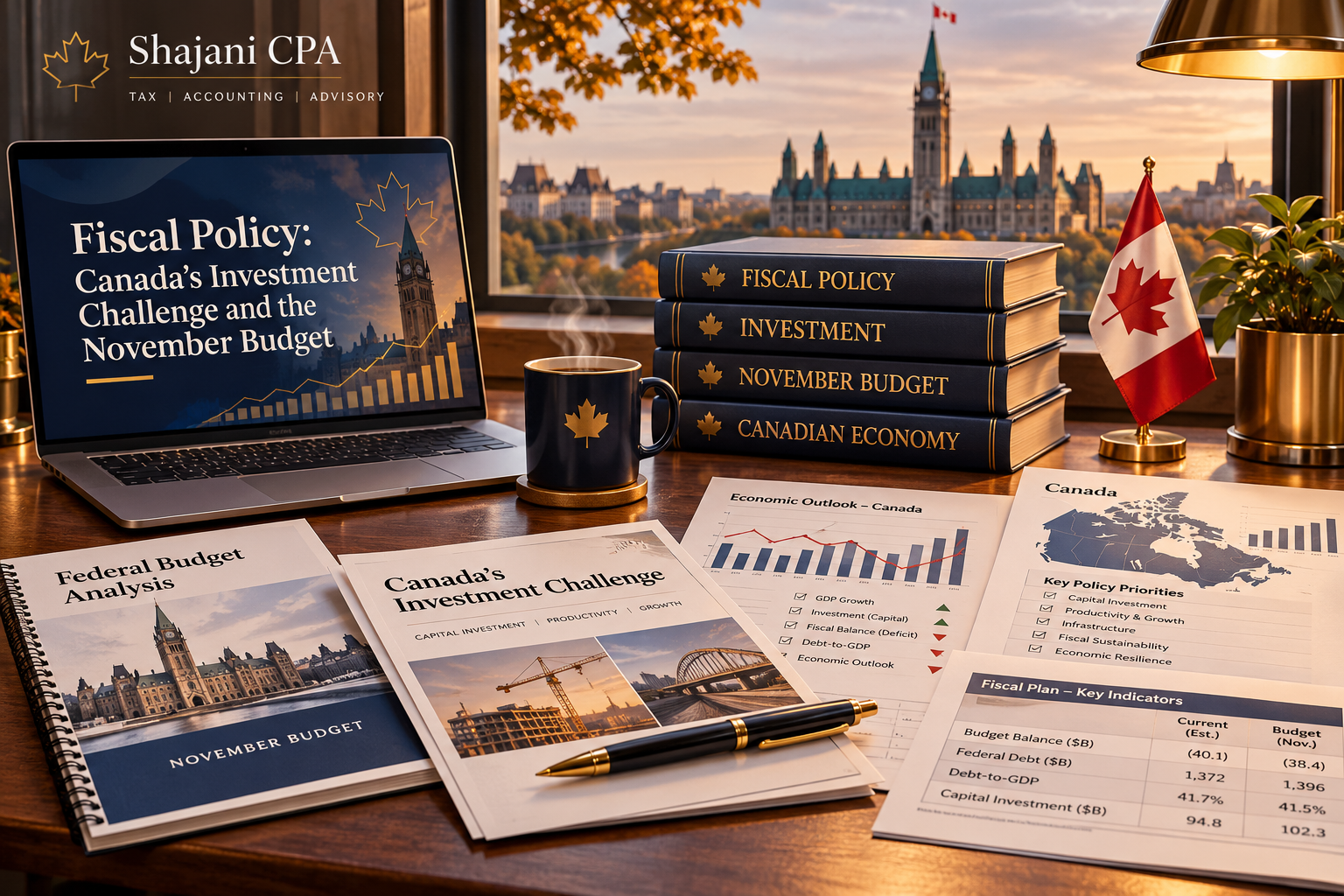
Fiscal Policy: Canada’s Investment Challenge and the November Budget
November decision brief
Canada enters November with a sharper fiscal problem than the one we described in our October edition. The federal government wants businesses to invest, retool and find customers beyond the United States. At the same time, the Parliamentary Budget Officer (PBO) now projects materially larger borrowing requirements, weaker real growth and persistent deficits. The November 5 federal budget is expected to set out the government’s next fiscal choices. [1][2]
For a family with a family-owned enterprise, the question is not whether a headline program sounds generous. It is whether a tax measure improves the after-tax return on a sound project; whether a support program addresses a genuine cash-flow constraint; and whether the enterprise can protect its employees, borrowing capacity and long-term family capital while the trade rules evolve.
Our fiscal-policy assessment is therefore selective: support productive investment and trade diversification, but do not confuse a government announcement with enacted tax law, a tax deduction with cash profit, or additional government borrowing with improved business competitiveness.
Four numbers that matter
| Indicator | November 1 reading | Why it matters |
| 2026–27 projected federal deficit | $63.3 billion | Sets the fiscal backdrop for new programs and tax proposals. |
| Five-year cumulative deficits | $333.3 billion | Indicates the persistence of projected operating fiscal pressures. |
| Five-year increase in federal borrowing | $732.9 billion | Includes financing for financial assets and loans; not equivalent to the deficit. |
| Proposed investment METR | 6.4% (Finance Canada model) | A modelled marginal effective tax rate after a proposed deduction—not the corporate tax rate. |
Source: Parliamentary Budget Officer, October 20, and Department of Finance Canada, September 2026. Fiscal amounts are projections; the METR is a government-modelled estimate conditional on the proposed measure. [1][3]
The October fiscal update: More revenue does not mean more real growth
The PBO reduced its 2026 Canadian real GDP growth projection to 0.9%, with 1.5% projected for 2027. At the same time, it increased its estimate of nominal GDP growth because higher oil and commodity prices raise the dollar value of economic activity. That distinction matters. Government revenues can improve because prices rise, even when businesses are not producing substantially more goods and services. [1]
Relative to its June outlook, the PBO identified $37.4 billion in additional fiscal room over five years, but reported that new spending and tax measures would cost approximately $52.6 billion over that period. It projects a $63.3 billion deficit in 2026–27, a peak of $70.2 billion in 2027–28, and deficits above $63 billion through 2030–31. [1]
A second figure deserves careful treatment. The PBO projects federal borrowing to increase by $732.9 billion over five years, considerably more than the cumulative deficits of $333.3 billion. The difference does not represent an additional $399.6 billion of ordinary program spending. Borrowing also finances loans, investments and other financial assets that are treated differently under accrual accounting. Nevertheless, those financing needs matter to public debt management and the wider capital market. [1]
For a business-owning family, the appropriate inference is not that every dollar of public borrowing will increase its bank rate. It is that fiscal policy must be judged by the productive capacity it creates. A commercially sound export terminal, grid upgrade or transportation corridor can expand future output. An inefficient project, however, still consumes scarce labour, materials and capital.
The tariff shock is also a fiscal-policy problem
The PBO estimates that the bilateral tariff measures introduced since early 2025, if they remain permanent, could reduce the level of Canadian real GDP by approximately 1.4% over the medium term compared with a no-tariff scenario. This is a scenario-based economic estimate, not an observed 1.4% decline in GDP. It nevertheless helps explain why the government is directing resources to affected industries. [1]
The federal government previously announced a $7.5 billion package of new and enhanced supports for workers and businesses affected by U.S. tariffs, including expanded regional tariff-response assistance and development-bank liquidity measures. Program eligibility, applications and funding availability are separate questions from the amount announced. [6]
A family enterprise should begin by separating three different problems. A temporary working-capital interruption may justify liquidity financing. A permanently uneconomic customer relationship requires repricing, renegotiation or market diversification. A productive expansion opportunity may warrant capital incentives or export-development assistance. Applying for the wrong program can consume management time without solving the business problem.
The Productivity Mega Deduction: Revisit the investment model, not the shopping list
Our October edition examined the proposed Productivity Mega Deduction in detail. The new November question is what a family enterprise should actually do before Parliament finalizes the measure. The Department of Finance proposes broader immediate expensing for qualifying depreciable property acquired on or after September 15, 2026, with deductions generally taken when the property becomes available for use. The government estimates that assets representing roughly two-thirds of capital investment would qualify, subject to important class-based exclusions and restrictions. [3]
Buildings in certain classes, goodwill and other intangible property, specified vehicles, and particular pipeline assets are among the exclusions. Special rules apply to some energy and industrial assets. This is proposed law as of the November 1 reporting date; the published rules and subsequent legislation must be reviewed before relying upon a deduction. [3]
The practical benefit is mainly timing. An Alberta company earning taxable income at the general 23% combined federal–provincial rate could potentially obtain a $230,000 current-year income-tax reduction from a fully deductible $1 million qualifying equipment investment, assuming adequate taxable income, eligibility and no other constraints. It is not a $230,000 permanent subsidy: ordinary capital cost allowance would otherwise have produced deductions in later years. The incremental value comes from receiving the deductions sooner. [3][4][5]
That distinction is especially important in a family enterprise. An unnecessary asset still consumes cash. An equipment purchase financed at a high borrowing rate may deteriorate liquidity even if the tax deduction is accelerated. Capital budgeting should compare after-tax net present value, financing, operating savings, implementation risk, and the effect on debt covenants under the current and proposed rules.
A practical $1 million investment decision
| Question | Appropriate management response |
| Will it increase productive capacity? | Quantify labour savings, higher throughput, less rework or improved gross margin. |
| What is the true tax benefit? | Model present value of deductions under proposed and existing CCA rules. |
| When is cash needed? | Forecast purchase deposits, financing draws, instalment-tax changes and installation costs. |
| Can the family bear the risk? | Test covenant headroom, dividend needs and the family’s liquidity reserve. |
Canada versus the United States: Compare the correct tax measures
It is tempting to argue that Canada should simply set its corporate income-tax rate below the U.S. rate. Tax competitiveness is important, but the comparison requires discipline. The general federal corporate rate in Canada is 15%, and Alberta adds 8%, producing a combined general rate of 23%. For qualifying Canadian-controlled private corporations earning active business income eligible for the small business deduction, the combined Alberta federal–provincial rate is generally 11% on eligible income, subject to applicable limits and grind rules. [4][5]
These statutory rates are not the same as the marginal effective tax rate (METR) on new investment. Finance Canada estimates that its proposed Mega Deduction would reduce Canada’s aggregate METR from 13.0% to 6.4%, compared with a modelled 16.9% U.S. METR. The estimate incorporates depreciation deductions, investment incentives and other tax features. It is a government model, not an enacted 6.4% corporate income-tax rate and not the actual rate paid by every Canadian business. [3]
My policy view is that Canada should test both lower corporate and personal income-tax burdens alongside accelerated deductions, predictable regulations and infrastructure. Lower statutory rates can improve the after-tax return on existing profits and encourage some investment, but they also reduce tax revenue unless sufficient additional activity or other offsets follow. A credible proposal needs a fiscal model, not an assumption that growth will automatically make a rate cut revenue-neutral.
Personal taxation is relevant because family enterprise owners ultimately make decisions about salary, dividends, reinvestment, retirement and succession at the family level. Corporate integration, access to the small business deduction, passive investment income, the lifetime capital gains exemption and ownership structures can materially affect the after-tax result. An apparently simple corporate rate reduction should not be analyzed in isolation from shareholder taxation.
Why a tax cut cannot completely offset a tariff
Consider a family-owned Canadian distributor with $1 million in domestic sales, $600,000 in U.S.-sourced inventory and $200,000 in other deductible operating costs. Assume the distributor absorbs a 25% surtax on all inventory, cannot change prices or volumes, and the surtax is included in deductible inventory cost as sold. This is an illustration, not a statement that every imported product faces that tariff.
| Operating result | Before the tariff | After the tariff |
| Revenue | $1,000,000 | $1,000,000 |
| Inventory cost | $600,000 | $750,000 |
| Gross profit | $400,000 | $250,000 |
| Other expenses | $200,000 | $200,000 |
| Taxable income | $200,000 | $50,000 |
| Corporate tax at 23% | $46,000 | $11,500 |
| After-tax income | $154,000 | $38,500 |
The business loses $115,500 of after-tax income even though its corporate tax bill falls automatically as taxable profits decline. If the corporate tax rate on the remaining $50,000 of income were cut to 20%, the additional saving would be only $1,500. Even a zero income-tax rate would leave just $50,000 of income after tax, far below the original $154,000.
The economic lesson is that a tariff attacks gross margin, whereas a corporate income-tax reduction generally assists only to the extent taxable income remains. Tax rate relief may improve resilience, but it cannot fully rescue a structurally loss-making product or customer relationship. Moreover, Canada’s tariff receipts cannot be assumed to offset the income-tax revenue lost across the wider economy: the amounts depend on import volumes, product coverage, commercial responses and the business tax base.
This is not an argument against tax reductions. It is an argument for choosing the right instrument for the problem—and for combining competitive tax policy with customs planning, commercial renegotiation, investment incentives, and alternative markets.
Infrastructure, trade corridors and the role of private capital
Canada’s long-term fiscal strategy should favour projects that expand its customer base and lower the cost of serving those customers. Transportation corridors, ports, electricity generation and transmission, processing plants, LNG infrastructure and commercially viable pipeline capacity can connect Canadian production to markets beyond the United States. These opportunities should be evaluated against forecast demand, financing costs, Indigenous consultation, environmental and other regulatory obligations, and expected returns.
The crucial distinction is between government financing that replaces private commercial discipline and government action that allows productive private capital to proceed. Faster, reliable approval processes and coordinated infrastructure can support investment without requiring government to own every project. Successful trade diversification also depends on the practical application of existing trade agreements, not merely their signing.
For a family-owned manufacturing or resource-services business, the most useful question is concrete: could a new transport corridor, terminal, processing facility or European customer justify a new plant, a second shift, a supplier relationship or an acquisition? The investment case must still work at the enterprise level.
Three decisions for the family enterprise before Budget 2026
Protect — update the 13-week cash forecast and covenant forecast. Model the impact of weaker sales, higher financing costs and delayed receivables. Establish the minimum cash and unused credit the family is prepared to preserve before dividends or shareholder draws are authorized.
Adapt — refresh the capital plan. List material proposed acquisitions, confirm the asset class and available-for-use timing, and calculate the project’s return under existing and proposed tax law. Review grants, loan supports and tax credits only after identifying the project’s commercial merits and its actual funding gap.
Grow — identify one defensible new Canadian or non-U.S. market and one productivity project. Allocate a responsible executive, an affordable pilot budget, milestones and a stop-loss threshold. Where a foreign subsidiary or distributor is contemplated, evaluate customs, transfer pricing, permanent-establishment and foreign reporting consequences before implementation.
For families with operating companies, holding companies, trusts or intercompany loans, these decisions should be made using the consolidated family-enterprise balance sheet. A company may be able to finance expansion while the family simultaneously faces mortgage commitments, estate-tax funding requirements or a pending ownership transfer. A good corporate decision can still be a poor family decision if the liquidity needs are not coordinated.
November conclusion: Measure the return, not the announcement
The November 5 federal budget should be judged by whether it strengthens Canada’s capacity to earn income and attract investment, rather than by the headline dollar value of spending or tax relief. The PBO’s October projections show the fiscal cost of the government’s choices. The proposed investment deduction shows the potential to improve the after-tax economics of productive projects. The tariff dispute shows why access to customers and competitive costs remain essential.
For family-owned enterprises, the correct response is neither to suspend investment nor to chase deductions. Preserve financial flexibility, invest where the after-tax economic return is defensible, and diversify customer and supplier risk deliberately. In the months ahead, those disciplines will matter more than any single fiscal announcement.
Tell us your ambitions, and we will guide you there.
Official sources and publication notes
Information cut-off: November 1, 2026. References are numbered for this standalone section and may be renumbered when merged into the complete monthly edition. All projections, illustrative calculations and un-enacted proposals are identified as such.
[1] Parliamentary Budget Officer, Economic and Fiscal Outlook, October 20, 2026 Official source [2] Department of Finance Canada, Budget 2026 to be tabled November 5 (October 20, 2026) Official source [3] Department of Finance Canada, Productivity Mega Deduction: backgrounder and proposed rules (September 2026) Official source [4] Canada Revenue Agency, Corporation tax rates Official source [5] Government of Alberta, Current provincial corporate income-tax rates Official source [6] Department of Finance Canada, Tariff countermeasures and $7.5 billion business supports (August 2026) Official sourceTell us your ambitions, and we will guide you there.
This information is for discussion purposes only and should not be considered professional advice. There is no guarantee or warrant of information on this site and it should be noted that rules and laws change regularly. You should consult a professional before considering implementing or taking any action based on information on this site. Call our team for a consultation before taking any action. ©2026 Shajani CPA.
Shajani CPA is a CPA Calgary, Edmonton and Red Deer firm and provides Accountant, Bookkeeping, Tax Advice and Tax Planning service.

Related Posts